ZA@WORKS
June 16, 2026 - June 18, 2026
ARB Head Office
Dovetailing with the key functions of the South African Reserve Bank – formulating monetary policy, monitoring financial markets, and ensuring financial stability and surveillance – and celebrating
the new, permanent museum space, the première exhibition aims to demonstrate, in visual manner, the imaging of work done by ordinary people in South Africa. Their work forms the cornerstone of the
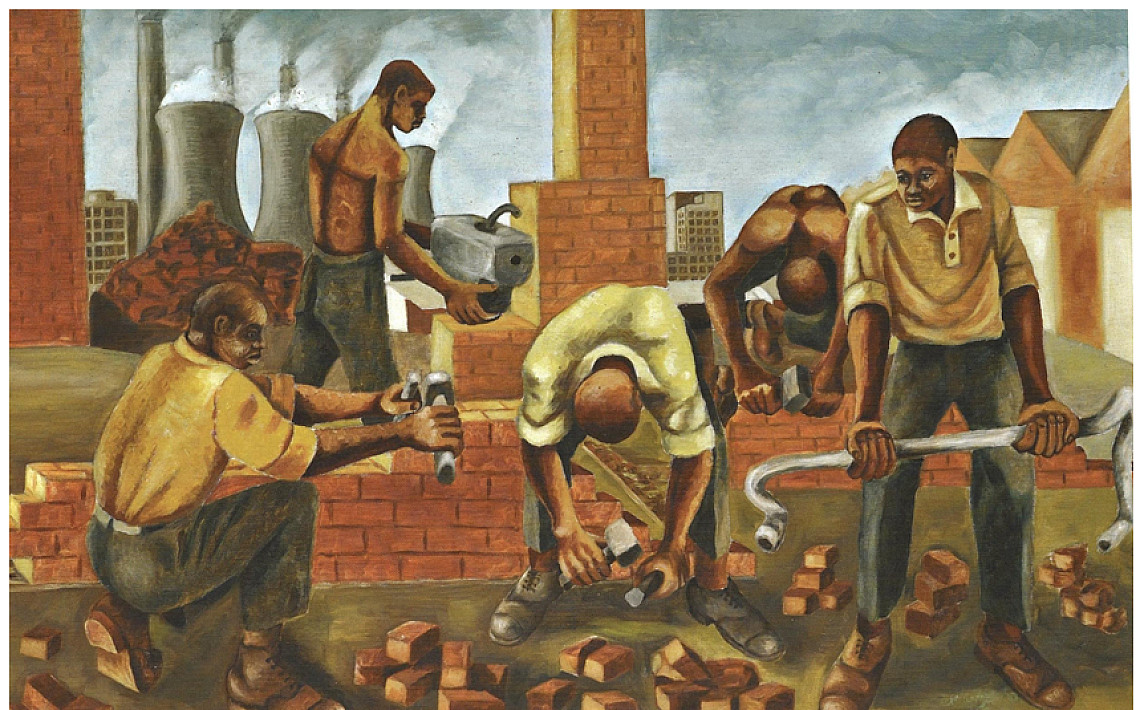
activities of the Reserve Bank; without their goods and services, there would not be a monitory policy or a financial market. Two key works constitute the nucleus of the show: S.E.B. Ngobo’s painting, Labourers (1969) (Fig 1) and Bill Ainslie’s Farm Workers (c1965) (Fig 2). They are similar in size and similar in their style of figuration and they both pay tribute to the worker in South Africa. These two paintings are augmented by the first commissioned work by Dorothy Kay for the Collection in 1943, titled Commerce (Fig 3). Conceptually, goods and services are visually turned into a veritable financial market in this work. Early international fiscal trade is represented in one of the first acquisitions of the Reserve Bank, namely, George Pilkington’s the depiction of a steamboat leaving Cape Town Harbour (1946) (Fig 4)The theme of the worker in art is hence expanded by the inclusion of such work as Gerard Sekoto’s painting of migrant workers, titled The Train Crowd (1945) (Fig 5), highlighting an important era of the discovery of gold on the Witwatersrand and the subs equent development of the mining industry in South Africa. Anton van Wouw’ s bronze sculpture, Miner (c1911) (Fig 6) complements this thematic strand well, asdoes JH Pierneef’s watercolour, titled, Johannesburg (1941) (Fig 7) showing the rapid rise of the metropole. Pierneef’s work contrasts well with the large-scale mixed-media work by Sam Nhlengethwa, titled, Working for You (1996) (Fig 8), showing a more contemporary view of the city.Following on the activities in and around the city, it is logical to include examples of the places where workers are staying and the culture they have made forthemselves. In this regard, such works by David Mogano (22nd Avenue, Old Alexandra) (Fig 9), David Twala (Mandela Park, 1999) (Fig 10), Trevor Makhoba (Umkhumbane, 1994) (Fig 11), George Pemba (At the Hospital, 1980) (Fig 12), and Gregoire Boonzaier (Morning, Caledon Street, District Six, Cape Town, 1967) (Fig 13) are pertinent inclusions in the show.These works are juxtaposed with the rural worker, depicted in such works as painted by Maggie Laubser (Landscape, Orange Free State) (Fig 14), Simon Lekgetho (Divination, 1961) (Fig 15), George Pemberton (Cape Vineyards) (Fig 16), Sydney Carter (Wynkelder) (Fig 17), George Canitz (Wheatfield, Malmsbury) (Fig 18), JH Pierneef (Landscape, Eastern Transvaal) (Fig 19), and Gladys Mgudlandlu (Two Girls, 1967) (Fig 20). A striking image in this genre, is Maud Sumner’s painting, called
Pipeline (Figure 21) showing how technology encroaches on unspoilt terrain.A pair of bronze sculptures by Ezrom Legae, African Goat and She Goat (Fig 22) provides another perspective of the rural worker, in this case, that of a shepherd or herder of cattle and livestock. Walter Wiles’ painting Op Trek (Fig 23) complements this genre, as does W.H. Coetzer’s Die Drif, 1956 (Fig 24).An indisputable fact of the lives of workers, is that their very existence has always been dominated by the general history of South Africa, and as such, art works by such artists as Penny Siopis (History Series: On the Beach Near the Military Hospital, Woodstock 1853 – 1995) (Fig 25) and Durant Sihlali (After the Bulldozer’s Demolition, Old Pimville) (Fig 26) are pertinent. Adding to the visualization of the plight of the worker under apartheid, are sculptures by such artists as Sydney Kumalo (Boy) (Fig 27) and Neels Coetzee (Monument for the Tormented, 1986) (Fig 28).A key aspect of the exhibition is the inclusion of two young contemporary artists’
work: Mohau Modisakeng (Fig 29), depicting a worker with outstretched arms, and Lobelo Tlotlo (Fig 30). The work is significant because it attests to the fact that the South African Reserve Bank supports emerging artists and contributing to their upskilling.